A tender here runs in four acts: a buyer publishes what they want and funds it, suppliers bid without seeing each other, the bids are scored against criteria fixed before any of them arrived, and the winner is paid milestone by milestone as the work lands.
Nothing about that is new. What is new is that each step leaves a record you can check yourself, rather than a claim you have to take on trust.
The problem this is built around
Two people who have never met want to trade, and each has a reason to hesitate.
The supplier is asked to quote a price, disclose their costs, and start work, all against a promise of payment from a company they cannot chase cheaply if it does not arrive. The buyer is asked to hand over money for goods they have not seen, to a supplier they cannot easily verify.
Procurement software has an answer to the second half. It has very little to say about the first, and almost nothing to say about the question a losing supplier actually asks: was that a fair tender, or had they already decided?
Who does what
Three parties act on a tender, and the point of the design is that none of them can do another's job. The evaluator judges but cannot award. The buyer awards but cannot judge for a second time. The contract enforces but decides nothing.
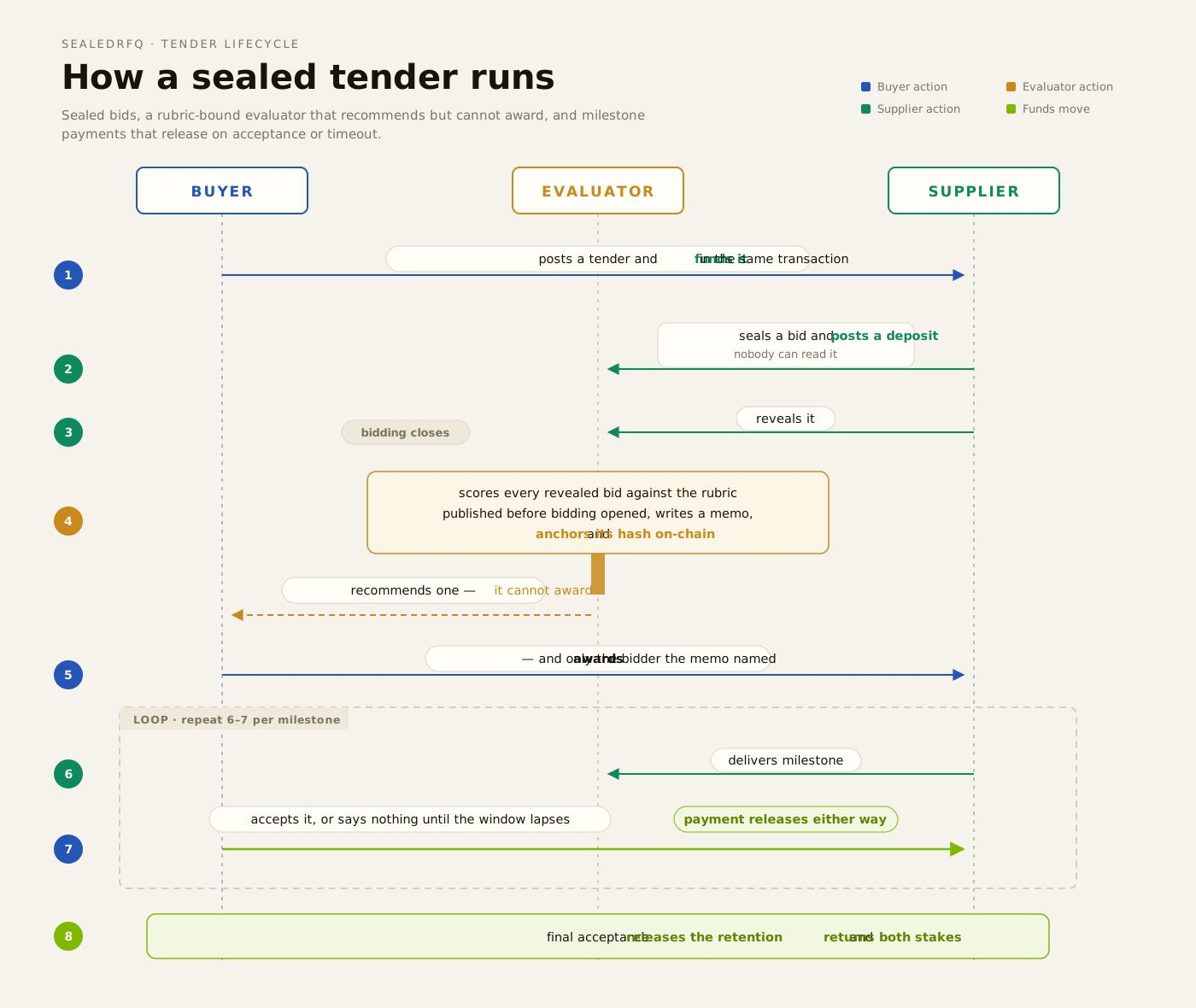
Every arrow above is a transaction somebody signed. The contract sits underneath all of them and refuses anything that breaks the published policy: over budget, too few bidders, a rubric that does not match the one fixed at the start, a delivery longer than the tender allows.
What each party cannot do
The negatives are the interesting half, because they are what the guarantees are made of.
| Can | Cannot | |
|---|---|---|
| Buyer | Publish and fund, invite, award, accept or reject a milestone with a reason, extend a delivery window, confirm receipt | Read a sealed bid, change the scope or rubric after posting, award anyone the evaluator did not name, award over budget, take back a released payment, cancel once a bid exists |
| Evaluator (the AI) | Score revealed bids, write and anchor a memo, flag a bid as non-compliant | Award anything. Score before the reveal window, score against a rubric other than the published one, move a single USDC |
| Supplier | Bid, reveal, deliver, dispute a rejection, reclaim a deposit | See a rival's price before reveal, change a bid after sealing it, extend their own deadline |
| Operator (us) | Hold role keys on this deployment. Which ones is listed in the README and readable on-chain | Read a sealed bid, move escrow that is not in dispute, exempt an award from a policy check, or reverse a released payment |
That last row deserves the detail rather than a reassuring summary. On this deployment the operator still holds role keys, and two of them matter: an arbiter can divide escrow on an engagement the parties have already put into dispute, and an admin can change the policy that future awards are checked against. Neither can reach a tender running normally, and neither can reverse a payment that has released. Saying "the operator cannot touch anything" would be false, so it is not claimed. Which roles are held is readable on-chain, and the README's table is meant to match what is actually held at the time you read it.
Where the AI actually sits
It is worth being blunt about this, because "AI procurement" usually means something looser.
The evaluator is deterministic arithmetic, not a language model: price, delivery and quality weighted by the rubric the buyer published before bidding opened. Run it twice on the same bids and it returns the same answer, which is the only reason a losing supplier can check it. It writes a memo explaining the result and anchors that memo's hash on-chain before any award is possible.
So the sequence is fixed: it reasons, then it is recorded, then a human commits. Not the other way round. A recommendation that appeared after the award would prove nothing.
And there is a cap on the other side of it. If an agent rather than the buyer sends the award
transaction, the contract refuses it above agentAwardCap. Above that figure a person signs, or
nobody does.
Act one: the buyer publishes a tender
The buyer writes what they need, what they will pay for it, and how bids will be judged, then funds the whole thing before a single supplier sees it.
That last part matters more than it sounds. The budget and the buyer's own stake are moved into escrow when the tender is posted. A supplier deciding whether to spend time on a bid can see the money is already there. A tender nobody funded is a request for free work, and this one cannot be posted.
Everything the buyer publishes (the scope, the line items, the scoring weights, the terms) is hashed, and that hash is written to the chain. Change a word afterwards and the hash no longer matches. The tender you bid on is the tender that gets judged.
Act two: suppliers bid, sealed
A sealed bid is submitted as a commitment: a hash of your price, your delivery time and your proposal, with a secret only you hold. The chain records that you bid and takes your deposit. It does not record what you bid, because nobody can read it yet: not rival bidders, not the buyer, and not us.
When bidding closes, everyone reveals. The contract checks each revealed price against the commitment made earlier, so a bid cannot be altered after seeing the competition.
The deposit is what makes this binding. Reveal, and you get it back whether you win or lose. Fail to reveal, and it goes to the buyer. Without the forfeit a sealed bid would be a free option: bid on everything, then reveal only where the price turned out well.
Some tenders run open instead, where every price is public as it arrives. That suits commodity buying where speed decides. It is a different promise, and the pages that report on it say which one was made.
Act three: the decision, and why it can be checked
Once bids are revealed, an evaluator scores each one against the rubric the buyer published before bidding opened, scoring price, delivery and quality at the stated weights. It writes a memo explaining the result, and anchors that memo's hash on the chain.
The scoring is arithmetic, not judgement. That is deliberate: a decision worth money should be one anybody can recompute, and a scorer that answered differently on a second run could not be checked at all.
Then the part that is unusual. The evaluator cannot award. It recommends and signs its reasoning. The buyer awards, and can only award the supplier the recommendation named. And the contract refuses an award that breaks the published policy, whoever asks: over budget, too few bidders, a rubric that does not match the one fixed at the start.
Three parties, three powers, none able to take another's. A losing supplier can read the memo, re-hash it, compare it with the chain, and see that the reasoning was written before the result and not after.
Act four: payment follows the work
The award does not hand over the money. It opens the first milestone.
Each milestone holds only its own share in escrow, less a retention withheld until the end. The supplier delivers, the buyer accepts, and that milestone releases. The most that is ever at risk is one milestone, not the whole contract.
If the buyer goes quiet, the milestone releases anyway once the acceptance window passes. A supplier who has delivered cannot be held hostage by silence.
Where a deployment charges a platform fee, it is taken here: a percentage of each milestone, deducted inside the escrow as that milestone is accepted, and borne by the supplier rather than added to the buyer's bill. Nothing accrues: it transfers to the treasury in the same transaction that pays the supplier, so no operator ever holds a balance of other people's money in transit. Retention is exempt, because final acceptance credits it directly rather than through an escrow job. The rate is published on the bid page and written into the tender's terms before anyone bids, because it changes what a supplier receives and they price against it. It is zero here.
If the supplier goes quiet, the delivery window closes and either party can settle the milestone. That takes a transaction somebody sends, because money here never moves on its own. The buyer recovers what was never earned, plus damages measured against what re-procuring would actually have cost, which the tender already knows because the next-cheapest bid was revealed. The rest of the supplier's stake comes back. A security is there to cover a loss, not to be confiscated because one occurred.
That cap has a condition worth stating: it needs a runner-up to measure against. A buyer who awarded something other than the cheapest revealed bid has no such measure, so nothing bounds the damages and the whole stake answers for the failure.
What this cannot do
The contract can check that a document matches a hash. It cannot see a container.
For a deliverable that is a file, such as a report, a design or code, the hash is the thing, and the guarantee is real. For physical goods the hash is a bill of lading: useful, checkable, and not the same as proof the goods exist or arrived. There is a receipt step and a transit allowance to keep the clock honest, but in the end a person inspects what turned up. The system's job is to make what they decide attributable and bounded by time, not to decide it for them.
It also cannot tell you a supplier is competent, solvent or real. It can tell you exactly what they have done here, counted from the chain, which is a smaller claim and a true one.